Flat roofs may look simple, but they’re one of the most challenging surfaces to protect. Because water doesn’t drain quickly, even light rain can sit on the surface for hours — or longer. Over time, this constant exposure leads to cracks, leaks, and gradual deterioration.
If you’ve ever dealt with a leaking flat roof, you already know how quickly a small issue can turn into a costly problem.
The good news is that modern waterproofing solutions have evolved significantly. Today, advanced roof waterproof coatings — especially liquid waterproof membranes — offer long-lasting, flexible protection that outperforms traditional systems.
In this guide, you’ll discover which coatings work best, how they compare, and how to choose the right solution for your roof.
Why Flat Roofs Need a Waterproof Coating
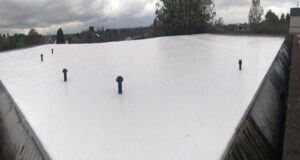
Unlike pitched roofs, flat roofs are not designed to shed water quickly. While they are built with a slight fall to encourage drainage, water often collects in low spots, around outlets, or in areas where the roof has settled over time. This results in what is commonly known as ponding water.
When water remains on a roof for prolonged periods, it places continuous stress on the roofing system. Over time, this can accelerate the ageing process of the roof membrane and increase the risk of failure.
- Common consequences of prolonged water exposure include:
- Gradual deterioration of roofing materials
- Cracking and splitting of membranes
- Failure of joints, seams, and flashings
- Water penetration beneath the roof surface
- Damage to insulation and substrates
- Internal leaks, dampness, and ceiling damage
One of the biggest concerns is that water can enter through even the smallest defect in the roof covering and become trapped beneath the membrane. In many cases, this hidden moisture may go unnoticed for months or years while it slowly damages the roof structure from within.
A high-quality waterproof coating provides a seamless protective barrier over the roof surface, helping to prevent water from penetrating the roofing system in the first place. By sealing vulnerable areas, eliminating weak points, and protecting the underlying substrate, a waterproof coating can significantly extend the lifespan of a roof while reducing future maintenance and repair costs.
Whether applied as part of a refurbishment project or incorporated into a new-build specification, a professional waterproofing system offers long-term protection against Ireland’s challenging weather conditions and the costly problems associated with water ingress.
If your roof is already showing signs of leaks, ponding water, or moisture damage, it is important to identify and address the source of the problem before applying any waterproof coating. A proper roof inspection and leak assessment will ensure that the coating system performs as intended and delivers lasting protection.
Types of Waterproof Coatings for Flat Roofs
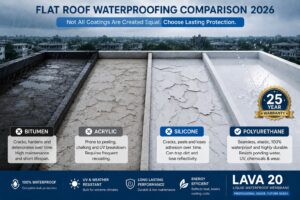
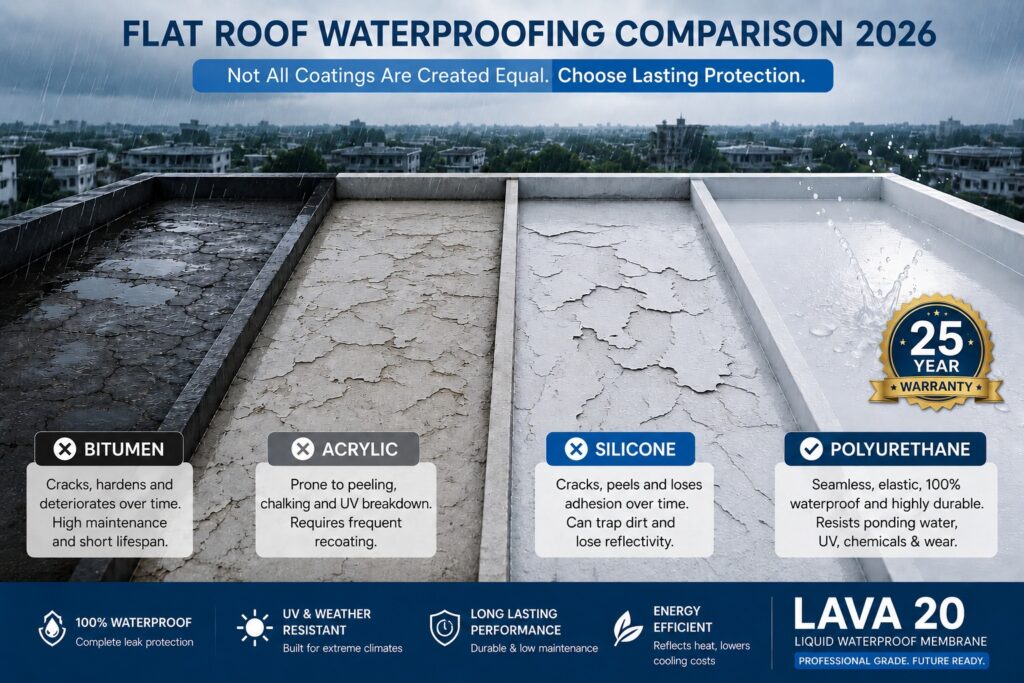
Not all waterproof coatings are created equal. Each type offers different levels of durability, flexibility, and protection.
Let’s break them down.
Bitumen Roofing Systems
Bitumen roofing systems have been used for decades and are still found on many flat roofs throughout Ireland and the UK. However, they rely on multiple layers, seams, overlaps, and joints — all of which create potential failure points.
As roofs expand and contract due to temperature changes, these joints can weaken, split, or separate, allowing water to penetrate beneath the waterproof layer.
Common Problems with Bitumen Systems
- Multiple seams and joints create leak risks
- Prone to cracking and splitting over time
- Difficult to achieve a completely seamless finish
- Requires ongoing maintenance and patch repairs
- Limited lifespan compared to modern liquid systems
Many flat roof leaks originate from failed joints and seams, making traditional bitumen systems increasingly difficult and expensive to maintain as they age.
Acrylic Roof Coatings
Acrylic coatings are often promoted as an affordable waterproofing option. However, they can struggle in Ireland and the UK’s wet climate where roofs are regularly exposed to heavy rainfall and standing water.
Common Problems with Acrylic Coatings
- Deteriorate relatively quickly
- Can contribute to ponding water issues
- Reduced performance in permanently wet conditions
- Require more frequent recoating
- Shorter service life than premium waterproofing systems
While acrylic coatings may provide temporary protection, they are generally considered a maintenance coating rather than a long-term waterproofing solution.
Silicone Roof Coatings
Silicone coatings are widely marketed for waterproofing, but many property owners are unaware of their practical limitations.
Although silicone can resist water, its surface is relatively soft compared to reinforced waterproofing systems.
Common Problems with Silicone Coatings
- Weak surface
- Easily damaged if not reinforced
- Difficult to repair once damaged
- Attracts dirt and contamination
- Repairs often require specialist preparation
Once damaged, silicone coatings can be challenging and expensive to repair properly, which can increase long-term maintenance costs.
Why they’re superior:
- No seams or joints to fail
- Flexible
- Strong adhesion across multiple surfaces
- Long-lasting
- Excellent resistance to weather and UV
For most situations, this is the best solution for flat roof waterproofing and repair.
Why Lava 20 Outperforms Traditional Waterproofing Systems
Many waterproofing systems fail because they rely on joints, seams, overlaps, or mechanically fixed components.
Lava 20 eliminates these common failure points.
Unlike traditional roofing products, Lava 20 forms a seamless polyurethane waterproof membrane that bonds directly to the substrate and creates a continuous protective layer.
Why Property Owners Choose Lava 20
- Seamless waterproof membrane with no joints to fail
- Excellent adhesion to concrete, felt, asphalt, timber, metal, EPDM and more
- Highly flexible and crack-bridging
- Resistant to ponding water
- UV stable and weather resistant
- Fast and easy application
- Suitable for refurbishment and new-build projects
- Backed by a 25-Year Warranty
Rather than simply covering a roof, Lava 20 creates a permanent waterproof barrier designed to withstand the demanding weather conditions experienced throughout Ireland, the UK, and Europe.
Waterproof Coating Comparison for Flat Roofs
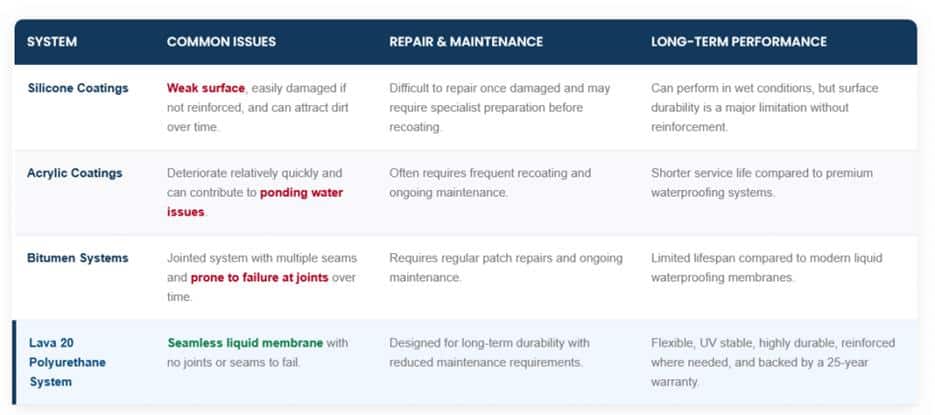
When comparing long-term durability, maintenance requirements, and overall waterproofing performance, reinforced polyurethane systems consistently outperform traditional bitumen, acrylic, and silicone coatings. By eliminating joints and creating a seamless waterproof membrane, Lava 20 provides greater protection against leaks, ponding water, UV exposure, and roof movement while significantly reducing ongoing maintenance costs.
Why Liquid Waterproof Membranes Perform Better
Traditional waterproofing systems depend on seams, overlaps, and joints.
Unfortunately, these are often the first areas to fail.
Every joint represents a potential entry point for water.
Liquid waterproof membranes eliminate this risk by creating a seamless waterproof layer across the entire roof surface.
Lava 20:
- Covers the entire roof without joints
- Seals cracks and vulnerable areas
- Adapts to building movement
- Prevents future water ingress
- Provides long-term protection against ponding water
This is why liquid polyurethane waterproofing systems have become the preferred solution for modern flat roof waterproofing projects.
How to Apply Waterproof Coating Properly
A good product alone isn’t enough — correct application is key.
Here’s the process simplified:
- Prepare the Surface
Clean thoroughly and remove loose materials.
- Apply Primer
This ensures strong bonding.
- Reinforce Weak Points
Use mesh on joints and cracks.
- Apply the Coating
Spread evenly across the surface.
- Allow to Cure
The coating forms a durable waterproof membrane.
Using a complete waterproofing kit makes this process easier and more reliable.
How to Choose the Right Waterproof Coating
Not every roof needs the same solution.
Ask yourself:
- Is the roof already leaking?
- How large is the area?
- Do I want a temporary fix or long-term solution?
Quick guide:
- Small repair → targeted coating or small kit
- Medium roof → full liquid membrane system
- Long-term solution → polyurethane-based system
The right choice depends on both your problem and your expectations.
Repair or Replace — What’s the Better Option?
Many people assume a leaking roof needs full replacement. In reality, that’s often unnecessary.
Repair is enough when:
- Damage is localized
- Structure is still intact
- Leaks are recent
Replacement is needed when:
- Damage is widespread
- Roof structure is compromised
- Multiple systems have failed
In many cases, a modern coating can restore the roof without full replacement.
Real-World Use Cases
For Homeowners
- Fixing leaks quickly
- Waterproofing balconies
- Preventing future issues
For Contractors
- Large-scale waterproofing
- Commercial buildings
- Fast, reliable application
The same system can work across both small and large projects.
Common Mistakes That Reduce Performance
Even the best coating can fail if applied incorrectly.
Avoid these:
- Skipping surface preparation
- Applying uneven layers
- Ignoring cracks and joints
- Working in poor weather conditions
Most failures happen during application — not because of the product.
Maintenance Tips to Extend Lifespan
Once applied, a waterproof coating requires minimal maintenance — but a little care goes a long way.
- Inspect roof annually
- Remove debris
- Check edges and joints
- Repair minor issues early
These simple steps can significantly extend performance.
For best results, explore a complete waterproofing system designed for flat roof repair and protection.