For decades, the roofing industry has focused on three key measures of performance:
Is it waterproof?
How long will it last?
How much maintenance does it require?
Today, a fourth question is becoming increasingly important:
How well does the roofing material preserve itself throughout its lifetime?
As sustainability becomes a priority across the construction industry, engineers, architects and building owners are looking beyond warranty periods. They are considering the long-term environmental impact of roofing materials, not just how long they last, but how they age over decades of exposure.
This shift is changing the way we think about waterproofing.
Every Roof Ages
Modern flat roofs are built using advanced polymer-based materials such as polyurethane, TPO, EPDM, PVC, acrylics and modified bitumen. These materials are engineered to withstand harsh weather conditions while providing decades of reliable waterproof protection.
However, there is one scientific fact that applies to every exposed polymer:
Every roofing material gradually weathers over time.
Continuous exposure to UV radiation, rain, temperature fluctuations, wind, dust and airborne contaminants slowly changes the surface of the material. This is a completely natural process known as polymer weathering.
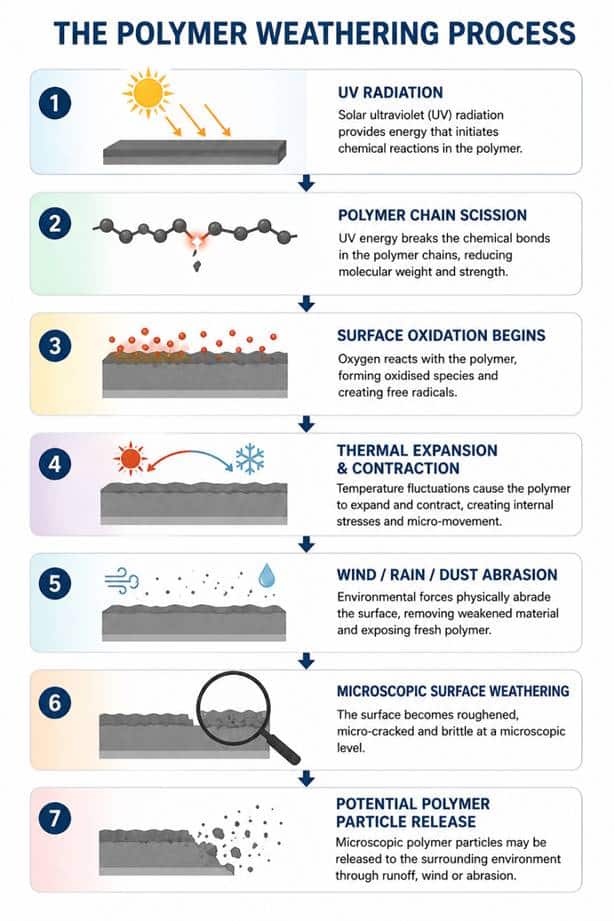
Weathering is not a product failure.
In fact, a roof can remain completely waterproof while microscopic changes occur on its surface over many years.
What Causes Roof Weathering?
A roof experiences some of the harshest environmental conditions of any building component.
Throughout its lifetime it is exposed to:
- Intense ultraviolet (UV) radiation
- Daily heating and cooling cycles
- Heavy rainfall and standing water
- Wind carrying dust and abrasive particles
- Foot traffic during maintenance
- Airborne pollution
Each of these environmental factors contributes, in different ways, to the gradual ageing of polymer roofing materials.
Over time, UV radiation slowly breaks down chemical bonds within the polymer structure. Temperature changes cause continual expansion and contraction. Wind-driven particles create microscopic abrasion, while moisture accelerates surface oxidation.
Individually, these effects are tiny.
Collectively, over decades, they slowly change the outer surface of the roofing membrane.
Why Material Stability Matters
Historically, the roofing industry has measured success by one simple question:
Does the roof remain waterproof?
Today, sustainability demands a broader perspective.
Engineers are increasingly asking:
How much of the original material remains after 20 or 30 years?
The longer a roofing system retains its physical integrity, the greater the benefits:
- Lower maintenance costs
- Fewer replacement cycles
- Reduced construction waste
- Lower embodied carbon
- Better lifecycle performance
- Reduced consumption of raw materials
Durability is no longer just an engineering goal, it has become an important measure of sustainability.
A Small Amount Across Millions of Roofs Becomes Significant
One individual roof contributes very little to global environmental impact.
However, when billions of square metres of roofing are considered together, even tiny changes become meaningful.
Research estimates that the world’s rooftops cover approximately 250–300 billion square metres, with around 30% consisting of flat or low-slope roofs protected by polymer waterproofing systems.
That equates to approximately:
90 billion square metres of flat roofing worldwide.
Now imagine every square metre of roof weathered by only one gram per year.
One gram is about the weight of a paperclip.
Most building owners would never notice such a tiny annual change.
Yet across the world’s flat roofs, that equates to approximately:
90,000 tonnes of material every year.
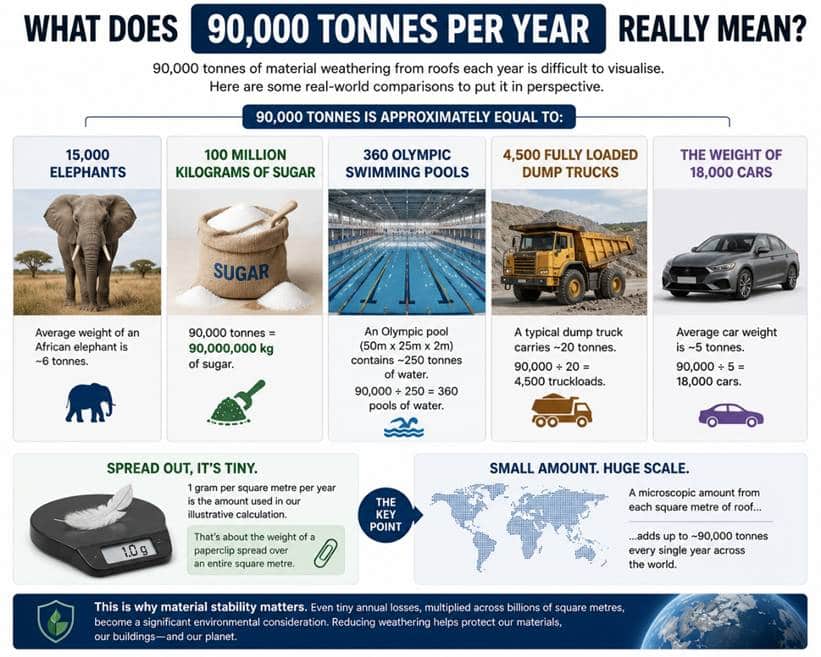
This is not presented as a measured global microplastic emission, but as an engineering illustration showing how seemingly insignificant changes become important when multiplied across global infrastructure.
Not All Roofing Systems Age the Same Way
Different waterproofing materials weather at different rates.
Their long-term performance depends on factors including:
- Polymer chemistry
- UV stability
- Roof colour
- Climate
- Temperature
- Installation quality
- Maintenance
- Mechanical wear
This is why selecting a high-quality waterproofing system is critical.
The goal is not to stop ageing altogether—that is scientifically impossible.
The goal is to minimise weathering and maximise service life.
Moving Beyond Sacrificial Coatings
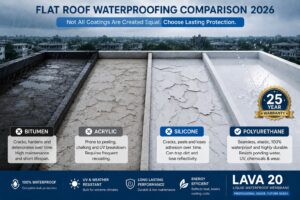
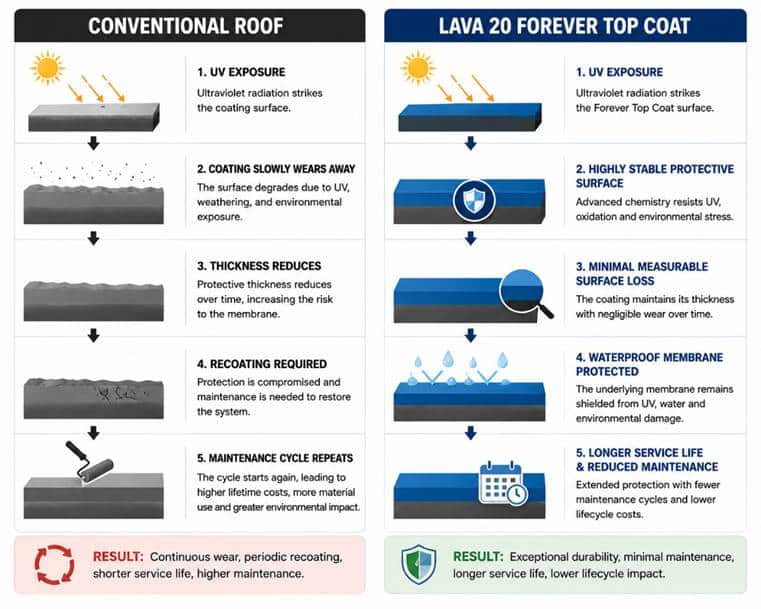
Traditional roof coatings have long followed what engineers call a sacrificial & organic design philosophy.
The coating gradually wears away while protecting the waterproofing system beneath it.
Eventually, enough material is lost that the roof requires recoating or maintenance.
This approach has served the industry well for many years.
However, as sustainability becomes increasingly important, a different engineering philosophy is emerging.
Rather than accepting gradual material loss as inevitable, manufacturers are developing technologies designed to retain their protective properties for much longer.
The Lava 20 Approach
The Lava 20 Waterproofing System has been developed around one simple principle:
The longer a roof retains its original performance, the more sustainable it becomes.
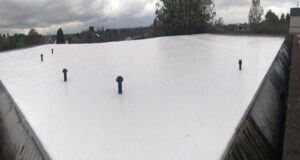
The seamless polyurethane membrane provides exceptional waterproofing, flexibility and crack-bridging performance with a 25 Year Warranty.
To further extend long-term durability, the system can be finished with the Lava 20 Forever Top Coat.
Unlike conventional sacrificial coatings, the Forever Top Coat has been engineered as a non-sacrificial protective layer.
Instead of slowly wearing away during normal service, it is designed to maintain its protective properties while helping preserve the waterproofing membrane beneath.
This approach offers significant long-term advantages, including:
- Exceptional UV resistance
- Outstanding colour stability
- Reduced surface weathering
- Lower maintenance requirements
- Longer service life
Durability Is Sustainability
Sustainability is often associated with recycled materials or lower manufacturing emissions.
While these are important, they are only part of the picture.
Every maintenance cycle requires:
- Additional materials
- Transport
- Packaging
- Labour
- Energy
- Waste disposal
A roofing system that continues performing for decades without frequent recoating or replacement consumes far fewer resources over its lifetime.
This is why modern sustainability frameworks increasingly focus on whole-life performance, not simply initial installation.
The most sustainable roof is often the one that remains in service the longest.
The Future of Roofing
The roofing industry is entering a new era.
Tomorrow’s waterproofing systems will not be judged solely by their warranties or waterproof performance.
Increasingly, they will also be evaluated on:
- Material stability
- Lifecycle performance
- Resource efficiency
- Environmental impact
- Long-term durability
As research into sustainable construction continues to evolve, one principle is becoming increasingly clear:
The best roof isn’t simply the one that lasts. It’s the one that preserves its performance, minimises maintenance and reduces environmental impact throughout its entire service life.
That is the future of roofing.
And it is the philosophy behind the Lava 20 Waterproofing System.